

Budapest may be where many journeys through Hungary begin, but it shouldn’t necessarily be where they end. Beyond the capital, the Hungarian countryside changes remarkably from one part of the country to another. Follow the Danube north and you’ll find riverside towns, wooded hills and medieval Visegrád. Travel west and the landscape around Lake Balaton becomes a mixture of volcanic hills, vineyards and small villages. Farther west, Őrség is known for forests and traditional rural landscapes, while northeastern Tokaj and southern Villány introduce two very different sides of Hungary’s wine country.
Since moving to Hungary, one of the things that has interested me most is how much of the country exists beyond the version visitors usually see in Budapest. Budapest is where our everyday life happens, but Hungary is small enough that a completely different landscape can be only a train ride or a few hours in the car away. We have already spent time around Lake Balaton and explored parts of Hungary as a family, but there are still many regions on my own list. That is partly why I wanted to create this guide: not as someone claiming to have visited every corner of the country, but as someone living here, discovering Hungary gradually and collecting the places that seem worth exploring next.
Some of the destinations below are places I know better than others, while Őrség, Tokaj and Villány are still places I would like to experience properly myself. Where I haven’t visited, I’ve relied on official tourism, national park and heritage information rather than presenting researched recommendations as personal experience. For me, that feels much more in keeping with what Szia Soul is about: discovering Hungary while actually building a life here.
1. Danube Bend: The Easiest Countryside Escape From Budapest
If you want to experience the Hungarian countryside without travelling across the entire country, start with the Danube Bend, or Dunakanyar. North of Budapest, the Danube winds between the Börzsöny and Visegrád Hills, creating one of Hungary’s most recognisable landscapes. The region combines historic towns, castles, hiking routes and long stretches of riverbank, while remaining close enough to Budapest for a day trip or weekend.
Szentendre is usually one of the first names you’ll encounter when researching the Danube Bend. Its historic centre is known for narrow streets, colourful houses, galleries, museums and its Danube promenade. It is close enough to Budapest to work as a straightforward day trip, particularly if you aren’t ready to organise a longer countryside journey. For a deeper look at rural Hungarian architecture and traditions, the Szentendre Open-Air Ethnographic Museum, or Skanzen, is another reason to spend more time in the area.
Continue farther along the Danube and the landscape becomes increasingly dramatic around Visegrád. The town is best known for its hilltop Citadel, which overlooks one of the most photographed stretches of the Danube Bend. Visegrád also has strong connections with medieval Hungarian royal history, while the surrounding hills provide opportunities for walking and hiking. It is one of those places where the landscape and history are difficult to separate, which is a large part of its appeal.
For a different perspective, cross to the other side of the river toward Nagymaros and continue toward Zebegény. Nagymaros gives you one of the classic views toward Visegrád, while Zebegény offers a quieter village atmosphere surrounded by the Börzsöny Hills. Both are situated on the Budapest–Szob railway line, making this side of the Danube particularly interesting if you’re exploring Hungary without a car.
At the western end of a longer Danube Bend itinerary, Esztergom adds another major historical stop. The city is dominated by the enormous Esztergom Basilica and sits directly beside the Danube at the Slovak border. Combining Szentendre, Visegrád and Esztergom in a single rushed day is possible, but the region makes much more sense when you allow yourself time to stop, walk along the river and explore rather than treating the journey as a sightseeing checklist.
The Danube Bend is therefore a particularly good choice if you want an easy escape from Budapest with river scenery, castles, Hungarian history and hiking. It also offers several destinations that can be reached without driving, which makes it one of the most accessible introductions to the Hungarian countryside for first-time visitors.
If you’re still spending part of your trip in the capital, you can combine this countryside escape with my guide to Budapest’s national attractions.

2. Balaton Uplands: Volcanic Hills, Villages and Lake Views
Lake Balaton is often associated with beaches and summer holidays, but the Balaton Uplands, or Balaton-felvidék, show another side of the region. North of the lake, the landscape is shaped by volcanic hills, vineyards, villages, lookout points and protected natural areas. This makes the region particularly interesting if you want to experience Lake Balaton without building your entire trip around swimming and beaches.
Lake Balaton is also the region in this guide that feels more familiar to me personally. We’ve visited Balaton several times since living in Hungary, and what I increasingly like about the area is that a trip doesn’t have to mean spending the entire day beside the water. Some of my favourite memories are connected with simply moving through the region, stopping in different towns and seeing how quickly the landscape changes once you move away from Budapest. It is one of the places that has made me want to explore much more of Hungary beyond the capital.
Tihany is one of the best-known destinations on the northern side of Lake Balaton. The peninsula is famous for its abbey, views across the lake, lavender and historic village atmosphere. Its popularity means it isn’t necessarily the place to go if your definition of countryside means having somewhere completely to yourself, but it makes an excellent introduction to the landscape and character of the northern shore.
Farther west, Badacsony is immediately recognisable because of its volcanic shape rising above Lake Balaton. The surrounding landscape combines hiking, vineyards and lake views, making it one of the places where the character of the Balaton Uplands is particularly easy to understand. Instead of seeing Balaton only from a beach, this part of the lake encourages you to look inland toward the hills and villages that surround it.
For smaller settlements and more rural landscapes, look toward the Káli Basin (Káli-medence). Villages, vineyards, old stone houses and the surrounding hills make this one of the parts of Balaton that fits especially well into a slower road trip. Rather than trying to cover the entire northern shore in a day, choose a base and explore a smaller area, leaving time for walks, viewpoints and spontaneous stops along the way.
The Balaton Uplands are particularly suitable if you want to combine Lake Balaton with volcanic landscapes, villages, hiking, vineyards and scenic driving or cycling. For a weekend or several days in western Hungary, the region offers considerably more than the traditional image of a summer beach holiday.
3. Őrség: Forests and Traditional Hungarian Village Landscapes
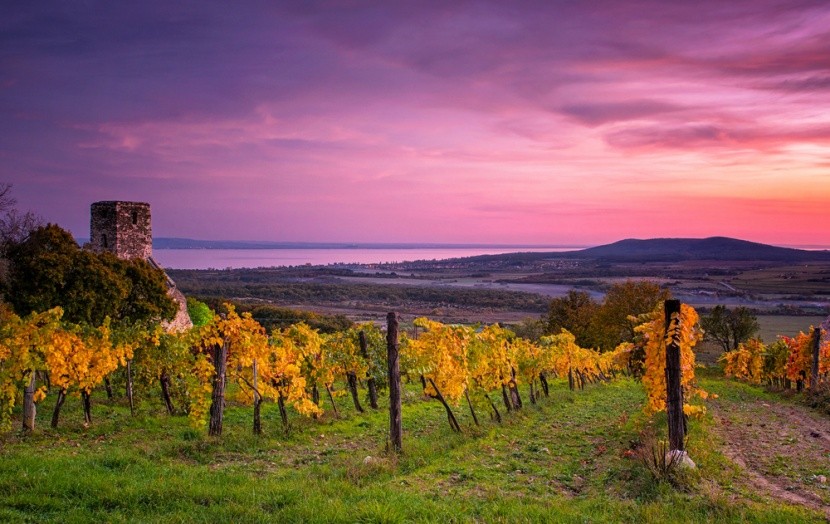
For something much quieter, look toward Őrség in western Hungary near the Slovenian border. This isn’t the Hungary of grand monuments and packed sightseeing itineraries. The attraction is the landscape itself: forests, meadows, small settlements and traditional rural architecture, much of it protected within Őrség National Park.
One of the characteristics that makes the region distinctive is its scattered settlement pattern. Instead of finding a dense collection of major tourist sights, you’ll encounter villages separated by green countryside, forests and agricultural land. Őriszentpéter is one of the principal settlements and can serve as a useful base for exploring the surrounding area, but the experience of Őrség is really about moving between these smaller communities and spending time outdoors.
The region is particularly associated with walking, cycling, local crafts and rural traditions. That means Őrség probably isn’t the right destination if your priority is filling every hour with famous attractions. For travellers specifically searching for a quieter Hungarian countryside getaway, however, that lack of a packed sightseeing schedule is part of the attraction.
A car gives you considerably more flexibility when exploring small settlements in this part of Hungary. If you have the time, Őrség is better approached as a slow countryside stay than as a rushed stop between larger destinations.

4. Tokaj: Hungary’s UNESCO Wine Landscape
In northeastern Hungary, Tokaj offers a completely different countryside experience. The Tokaj Wine Region Historic Cultural Landscape has been a UNESCO World Heritage Site since 2002, and its importance isn’t based on one monument or attraction. The landscape itself, including vineyards, historic settlements and networks of wine cellars, reflects centuries of viticulture and the development of one of Hungary’s most internationally recognised wine regions.
Even if wine isn’t the main reason you travel, this combination of cultural landscape, villages and northeastern Hungarian scenery makes Tokaj worth looking beyond as simply the name printed on a bottle. The town of Tokaj, situated close to the meeting of the Bodrog and Tisza rivers, makes a natural starting point for exploring the area. From here, the wider region opens into vineyard-covered hills and settlements strongly connected with wine production.
Mád is another important settlement within the wine region, while Tarcal lies close to Tokaj beneath the volcanic Tokaj Hill. If you’re staying for more than a quick visit, exploring several settlements gives you a much better understanding of the region than remaining only in Tokaj town. A longer northeastern Hungary itinerary can also extend to Sárospatak, with its Rákóczi Castle, and the surrounding Zemplén Mountains, adding history, forests and hiking possibilities to the journey.
That variety makes Tokaj particularly suitable for a two- or three-day trip rather than simply arriving for a wine tasting and leaving again. The region works well for travellers interested in Hungarian cultural heritage, historic wine cellars, small towns and landscapes where centuries of agriculture have shaped what you see today.

5. Villány: Southern Hungary’s Vineyard Country
Our final region takes us south to Villány, close to Croatia and not far from Pécs. Villány is one of Hungary’s best-known wine regions, particularly associated with red wines, and the Villány–Siklós area has a noticeably different atmosphere from Tokaj in the northeast. The climate has sub-Mediterranean influences, while the landscape includes vineyards, low hills and distinctive rows of wine cellars.
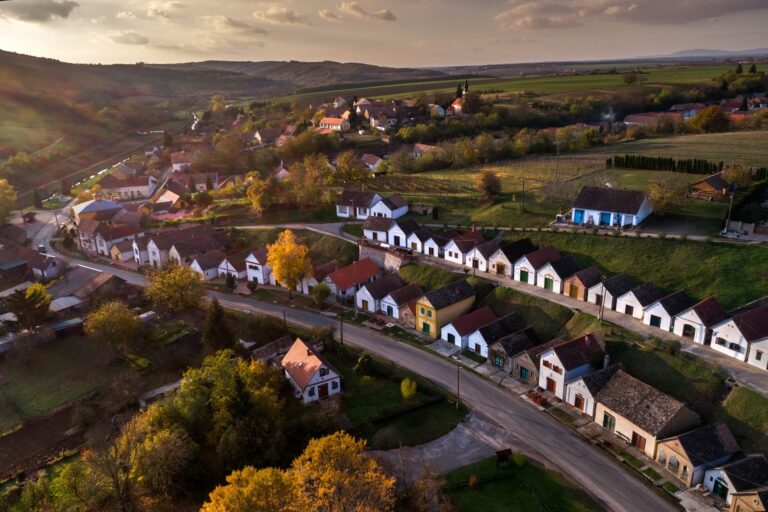
The cellar streets are one of the most recognisable features of Villány. Historic press houses and cellars have become an important part of the visitor experience, with tastings and restaurants concentrated within a relatively small area. Nearby Palkonya is known for its traditional cellar village and makes an interesting addition if you’re exploring beyond Villány itself.
Siklós adds another dimension to a trip through the region, particularly through Siklós Castle. Together, Villány, Palkonya and Siklós make it possible to build a countryside itinerary that isn’t exclusively about wine. Cycling and hiking are also options in the surrounding Villány Hills, so a visit can combine vineyards, food, history and outdoor activities.
Villány makes the most sense as a relaxed southern Hungary getaway, particularly for travellers already planning to visit Pécs or explore this part of the country. As with Tokaj, staying locally also means you don’t need to rush back to Budapest at the end of the day.
Which Hungarian Countryside Region Should You Choose?
If you only have one day from Budapest, the Danube Bend is the most straightforward of these five regions. For a combination of lake scenery, hiking and villages, look at the Balaton Uplands, while those wanting forests and a deliberately quieter rural break should consider Őrség.
If cultural landscapes and centuries of wine tradition interest you, Tokaj deserves more than a rushed visit. For a southern Hungarian getaway centred around vineyards, cellar villages and nearby historic sights, Villány offers another very different option. You don’t need to visit all five, and choosing one region and exploring it properly is much closer to the idea of slow travel than spending a week driving from one end of Hungary to the other just to tick destinations off a list.
Can You Explore the Hungarian Countryside Without a Car?
For some regions, absolutely. The Danube Bend is the easiest choice on this list for public transport. Szentendre is accessible from Budapest, while towns including Nagymaros and Zebegény can be reached by train. Lake Balaton also has extensive rail connections, although getting from a railway station to smaller inland villages can require additional planning.
For Őrség, a car makes exploring scattered villages considerably easier. Tokaj itself can be reached by train, but having a car provides more flexibility if you want to explore several wine villages and the wider Zemplén region. The same applies to Villány: public transport can get you into the area, but a car can simplify a wider countryside itinerary.
If wine tasting is part of your plans, however, don’t build your day around driving yourself between wineries. Arrange appropriate transport, travel with a non-drinking driver or stay locally so that you can enjoy the region without worrying about the return journey.
Where to Stay in the Hungarian Countryside
Accommodation can shape the entire experience when you travel outside Budapest. Depending on the region, you’ll find hotels, guesthouses, apartments, traditional houses, vineyard accommodation and countryside stays. Staying overnight also lets you experience these places after day visitors have gone home and gives you considerably more freedom to explore without watching the clock.
Rather than searching accommodation websites one by one, you can use cozycozy to compare accommodation options from different booking platforms in one search. For a Danube Bend weekend, look around Szentendre, Visegrád, Nagymaros or Zebegény depending on which part of the region you want to explore. Around Balaton, choose your base according to the part of the northern shore you actually plan to visit rather than simply searching for “Lake Balaton.”
In Őrség, a smaller guesthouse or rural stay fits naturally with the destination, while Tokaj has accommodation both in the town itself and across the surrounding wine region. Villány also offers places to stay close to its cellar district and vineyards, which can be particularly convenient if food and wine are part of your plans.
Compare places to stay in Hungary with cozycozy →
Disclosure: This article may contain affiliate links. If you book through one of these links, Szia Soul may earn a commission at no additional cost to you.
When Is the Best Time to Explore the Hungarian Countryside?
There isn’t one perfect season for all five regions. Spring brings greener landscapes and comfortable temperatures for sightseeing and hiking, while summer is particularly popular around Lake Balaton and gives you longer days for outdoor activities. Popular Balaton destinations can also become considerably busier during the summer months, so this is worth considering if you’re specifically looking for a quiet countryside break.
Autumn is especially interesting in vineyard regions such as Tokaj and Villány and in forested areas as the leaves begin to change. Winter creates a much quieter experience, but some countryside attractions, accommodation and seasonal businesses may operate reduced hours. For countryside trips, it makes more sense to plan around what you actually want to do than to choose a region first and then try to force it into the wrong season.
Hungarian Countryside FAQ
What is the Hungarian countryside like?
There isn’t one single Hungarian countryside landscape. Depending on where you travel, you’ll find river valleys, forests, plains, vineyards, volcanic hills, lakes and small villages. The Danube Bend and Balaton Uplands, for example, look very different from Őrség or Tokaj, which is why travelling beyond Budapest can reveal so many different sides of Hungary.
What is the best countryside near Budapest?
The Danube Bend is one of the easiest countryside regions to explore from Budapest. Szentendre, Visegrád, Nagymaros, Zebegény and Esztergom provide combinations of history, river scenery and outdoor activities without requiring a journey across the entire country.
What are the best Hungarian countryside villages to visit?
Rather than choosing villages purely from a ranking, it is more useful to look at regions. Zebegény in the Danube Bend, villages of the Káli Basin around Balaton, settlements in Őrség, Mád in the Tokaj region and Palkonya near Villány each represent very different parts of rural Hungary.
Can I take a train through the Hungarian countryside?
Yes. Rail travel is particularly useful for destinations along the Danube Bend and around Lake Balaton, while Tokaj is also connected by train. Smaller villages may require buses, taxis, bicycles or a car for the final part of the journey, so check the complete route rather than only whether the nearest town has a railway station.
Is the Hungarian countryside worth visiting?
If your trip allows enough time, travelling beyond Budapest reveals landscapes, towns and regional traditions you won’t experience by staying exclusively in the capital. You don’t necessarily need a week-long road trip either; even a Danube Bend day trip can provide a very different view of Hungary.
Is the Hungarian countryside good for families?
It can be. Lake Balaton and the Danube Bend are particularly easy regions to consider for family trips because you can combine outdoor activities with towns and attractions. The best destination will depend on your children’s ages, the season and how much travelling you want to include in each day.
Beyond Budapest: Discovering More of Hungary
When I first moved to Hungary, naturally most of my attention was on Budapest and the practical side of starting a new life here. The longer I live here, however, the more interested I become in what lies outside the capital. Our trips around Balaton and the places we’ve discovered gradually as a family have made me realise how easy it is to build an image of Hungary around Budapest alone, when the landscapes, traditions and pace of life can change considerably once you leave the city.
You don’t have to experience all of them at once. Choose a region that matches the way you like to travel, give yourself enough time to explore it, and use the journey as an opportunity to see a different side of Hungary. For more ideas beyond the capital, continue exploring Szia Soul for practical guides and travel inspiration from Hungary.
 Barati Slagjana