

Hungary’s national symbols and holidays tell much of the country’s story. The red, white and green flag, the historic coat of arms, the Holy Crown and the Himnusz are all closely connected with Hungarian identity, while the country’s three national holidays commemorate some of the most important events in Hungarian history.
If you’re living in Hungary, these symbols and dates quickly become familiar. Hungarian flags appear throughout Budapest around national celebrations, public buildings are decorated, and major commemorations take place around Parliament, museums and other historic locations. They were particularly important for me because Hungary’s national symbols and holidays were part of the material I studied for the Magyar Kulturális Ismereti Vizsga. I took the exam in Budapest in April 2026 after around three months of preparation and scored 30/30.
In this guide, I’ll explain the most important national symbols of Hungary, the country’s three national holidays and the Hungarian names worth knowing-whether you’re learning about Hungarian culture or preparing for the exam.
What Are the National Symbols of Hungary?
The most important national symbols you should recognise are:
- Magyarország zászlója – Flag of Hungary
- Magyarország címere – Coat of arms of Hungary
- Szent Korona – Holy Crown of Hungary
- Himnusz – National anthem
Hungary’s Fundamental Law officially defines the country’s coat of arms, flag and national anthem. It also recognises the historic significance of the Holy Crown in its National Avowal.
The Hungarian Flag – Magyarország Zászlója

The flag of Hungary is probably the easiest Hungarian national symbol to recognise. It consists of three horizontal bands of equal width:
- Red – Piros
- White – Fehér
- Green – Zöld
The colours are not simply decorative. The Fundamental Law gives them specific symbolic meanings:
- Red represents strength – erő.
- White represents loyalty – hűség.
- Green represents hope – remény.
This is worth remembering if you’re preparing for the Cultural Knowledge Exam because questions about the order and meaning of the Hungarian flag colours can appear in exam preparation. During national celebrations, you’ll see the red-white-green tricolour displayed across Budapest and other Hungarian towns and cities. One of the most symbolic ceremonies takes place at Kossuth Lajos Square outside the Hungarian Parliament, where Hungary’s national flag is ceremonially raised as part of major national commemorations.
Coat of arms of Hungary – Magyarország címere
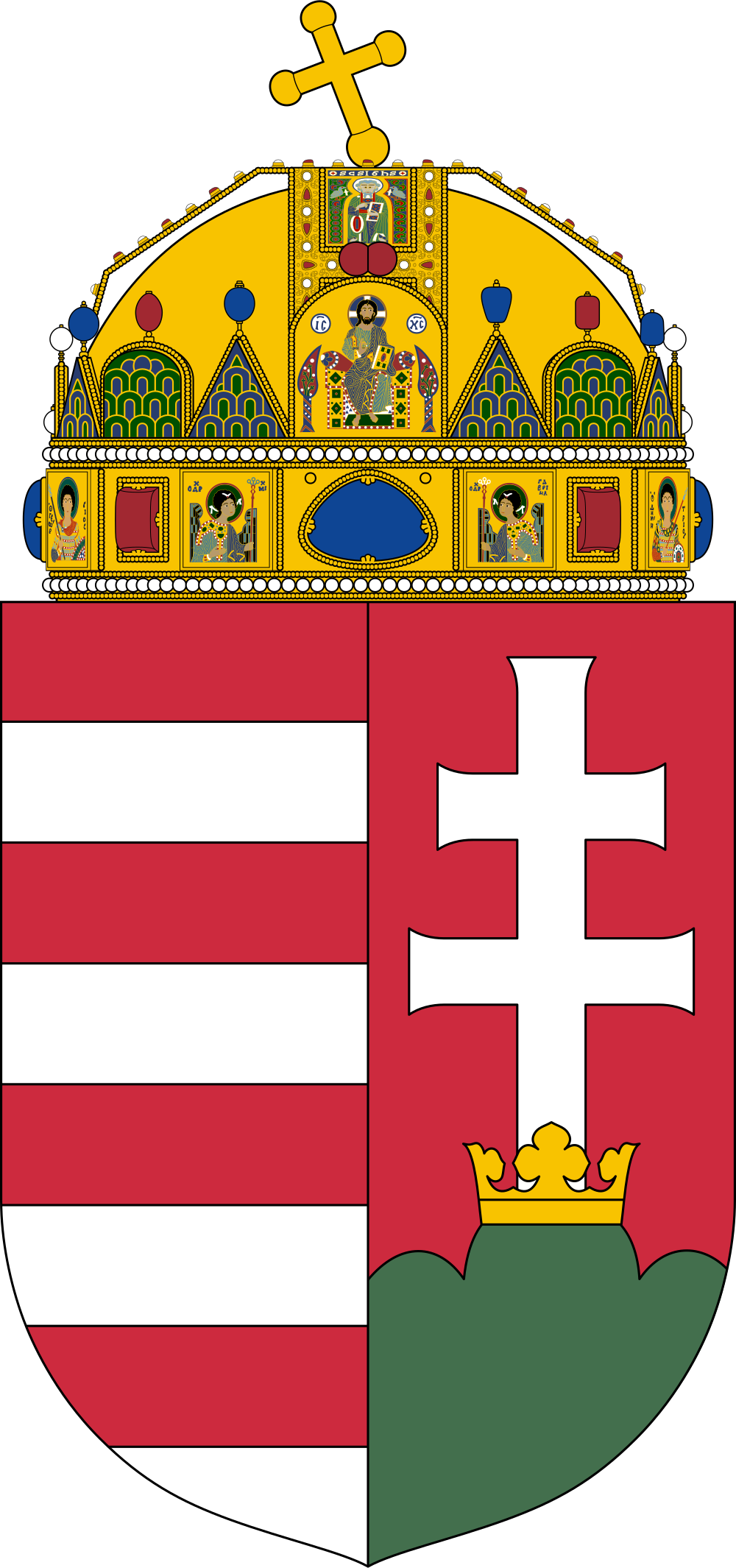
The Hungarian coat of arms is more complicated than the flag, but once you know what you’re looking at, its individual elements become much easier to recognise. The coat of arms includes:
- the Holy Crown
- red and silver horizontal stripes
- a double cross
- a three-peaked green hill
- a crown beneath the double cross
The Fundamental Law provides the official description of Hungary’s coat of arms. For exam preparation, I found it more useful to understand the different parts visually instead of trying to memorise one long Hungarian description. If you are studying the constitutional side of this topic as well, continue with my guide to the Fundamental Institutions of the Fundamental Law in Hungary.
The Holy Crown of Hungary – Szent Korona

The Holy Crown of Hungary (Szent Korona) is one of the country’s most important historical symbols.
It is strongly associated with the Hungarian monarchy and the coronation of Hungarian rulers. The Holy Crown also has a special place in Hungary’s constitutional and national tradition. Hungary’s Fundamental Law refers to the Holy Crown as embodying Hungary’s constitutional continuity and the unity of the nation.
Today, you can see the Holy Crown inside the Hungarian Parliament Building in Budapest, together with other coronation insignia. If you’re visiting Budapest and want to connect what you’re learning with actual places, see my guide to Budapest’s national attractions and important landmarks.
Hungarian Coronation Insignia – Koronázási Jelvények

The historic Hungarian coronation insignia are another part of the country’s royal heritage.
The principal items include:
- Szent Korona – Holy Crown
- Koronázási jogar – Coronation sceptre
- Országalma – Globus cruciger / orb
- Koronázási kard – Coronation sword
- Koronázási palást – Coronation mantle
If you’re learning these for the Cultural Knowledge Exam, I recommend learning the Hungarian names alongside the English ones. That was the method that worked best for me throughout my preparation: first understand what something is, and then learn the Hungarian terminology associated with it.
Former Hungarian coronation cities – Egykori magyar koronázó városok

- Buda
- Esztergom
- Pozsony
- Sopron
- Székesfehérvár
„Tiszteletben tartjuk történeti alkotmányunk vívmányait és a Szent Koronát, amely megtestesíti Magyarország alkotmányos állami folytonosságát és a nemzet egységét.”
“We respect the achievements of our historic constitution and the Holy Crown, which embodies the constitutional state continuity of Hungary and the unity of the nation.”
Magyarország Alaptörvénye – Fundamental Law of Hungary
The Hungarian National Anthem – Himnusz
Hungary’s national anthem is the Himnusz.
The poem was written by Ferenc Kölcsey (Kölcsey Ferenc) in 1823. Its music was composed by Ferenc Erkel (Erkel Ferenc). These two names are important to remember:
- Kölcsey Ferenc → wrote the Himnusz
- Erkel Ferenc → composed its music
The Fundamental Law formally identifies Kölcsey’s Himnusz, with music by Erkel, as Hungary’s national anthem. You don’t need the entire poem reproduced here to understand its significance. If you’re studying for the Cultural Knowledge Exam, concentrate on recognising the name Himnusz and associating Kölcsey and Erkel with their respective roles. You can learn more about the writers and composers included in the exam material in my guide to Hungarian literature and music history.

| Isten, áldd meg a magyart Jó kedvvel, bőséggel, Nyújts feléje védő kart, Ha küzd ellenséggel; Bal sors akit régen tép, Hozz rá víg esztendőt, Megbünhödte már e nép A multat s jövendőt! |
What Is the Szózat?
The Szózat is another important Hungarian patriotic work, but it is important not to confuse it with the national anthem.
Mihály Vörösmarty (Vörösmarty Mihály) wrote the Szózat in 1836, while Béni Egressy (Egressy Béni) composed its music.
So remember:
- Himnusz → Kölcsey Ferenc + Erkel Ferenc
- Szózat → Vörösmarty Mihály + Egressy Béni
The distinction is particularly useful when preparing for exam questions because it is easy to mix up the writers and composers.
„Hazádnak rendületlenűl
Légy híve, oh magyar;
Bölcsőd az s majdan sírod is,
Mely ápol s eltakar.
A nagy világon e kivűl
Nincsen számodra hely;
Áldjon vagy verjen sors keze;
Itt élned, halnod kell.”

National Holidays in Hungary
Hungary has three national holidays (nemzeti ünnepek) established in the Fundamental Law:
- 15 March – Március 15.
Commemorating the Revolution and War of Independence of 1848–49. - 20 August – Augusztus 20.
Commemorating the foundation of the Hungarian state and King Saint Stephen. - 23 October – Október 23.
Commemorating the Revolution and War of Independence of 1956.
Of these three, 20 August is designated as Hungary’s official state holiday (hivatalos állami ünnep).
These dates are important beyond the Cultural Knowledge Exam. If you live in or visit Hungary, they affect everyday life too. Public celebrations, ceremonies and special events take place around the country, while shops, government offices and many services may operate differently on public holidays.
March 15 – Március 15.: The 1848 Revolution
15 March commemorates the Hungarian Revolution and War of Independence of 1848–49. This is probably the national holiday I found easiest to remember while preparing for my exam because the 1848 Revolution was one of the historical topics I found particularly interesting. The revolution began as part of the wider revolutionary movements spreading across Europe in 1848. In Hungary, figures including Sándor Petőfi (Petőfi Sándor) became closely associated with the events of 15 March.
Petőfi’s Nemzeti dal (National Song) became one of the iconic literary works associated with the revolution. On 15 March, you’ll commonly see people wearing a kokárda, a small red-white-green cockade representing the Hungarian national colours. In Budapest, official commemorations traditionally include events around important historic locations. For example, Hungary’s official 2026 programme included the ceremonial raising of the Hungarian flag at Kossuth Lajos Square and programmes at the Hungarian National Museum. If you’re studying this date, the essential association is:
15 March → 1848–49 Revolution and War of Independence
August 20 – Augusztus 20.: Saint Stephen’s Day
20 August is one of the biggest holidays in Hungary and is officially designated as the country’s state holiday. It commemorates the foundation of the Hungarian state and King Saint Stephen (Szent István király), Hungary’s first king and state founder. For someone new to Hungary, August 20 is also one of the most visible national celebrations of the year. Budapest normally becomes a major centre of events and celebrations surrounding the holiday. Saint Stephen is an especially important figure in Hungarian history, and you’ll encounter his name throughout Budapest. One of the capital’s most recognisable landmarks is St. Stephen’s Basilica (Szent István Bazilika).
If you’re preparing for the exam, remember the simple connection:
20 August → foundation of the Hungarian state + King Saint Stephen
The date is particularly important because, unlike March 15 and October 23, the Fundamental Law specifically identifies August 20 as Hungary’s official state holiday.
October 23 – Október 23.: The 1956 Revolution
23 October commemorates the Hungarian Revolution and War of Independence of 1956. The uprising began on 23 October 1956, when demonstrations in Budapest developed into a revolution against Soviet-backed communist rule. The revolution was ultimately suppressed by Soviet forces, but 1956 remains one of the defining events of modern Hungarian history. October 23 also carries another major historical association: the Republic of Hungary was proclaimed on 23 October 1989, marking a key moment in Hungary’s transition away from communist rule.
For exam purposes, the core association is:
23 October → 1956 Revolution and War of Independence
National Holidays vs Public Holidays in Hungary
This distinction is useful if you found this article while searching for holidays in Hungary rather than specifically studying Hungarian history. Hungary’s three national holidays are March 15, August 20 and October 23. But these are not the only public holidays or non-working holiday dates observed in Hungary. Other important public holiday periods include religious and traditional celebrations such as Easter, Pentecost, All Saints’ Day and Christmas, as well as New Year’s Day and Labour Day.
So if you’re planning travel, shopping or appointments in Hungary, don’t assume that only the three national holidays affect opening hours. This is particularly important with supermarkets. Large stores can operate very differently on public holidays, so if you’re living here, see my Hungarian Supermarkets for Expats & Travellers guide for more practical information about everyday shopping in Hungary.
National Symbols and Holidays for the Hungarian Cultural Knowledge Exam
I originally studied all of this because national symbols and holidays form part of the knowledge material for the Magyar Kulturális Ismereti Vizsga. I prepared seriously for around three months before taking the exam in Budapest in April 2026. I eventually scored 30/30. One thing that helped me enormously was not trying to memorise Hungarian sentences without understanding them.
For example, rather than simply memorising:
piros – erő
fehér – hűség
zöld – remény
I made sure I understood that the question could ask me about the colours of the Hungarian flag, their order or what each colour symbolises. The same applied to names. Instead of seeing Kölcsey Ferenc, Erkel Ferenc, Vörösmarty Mihály and Egressy Béni as four names to memorise, I connected each person with a specific work and role. That made the information much easier to recall.
You can read my full experience in Hungarian Cultural Knowledge Exam: How I Scored 30/30.
Practice Questions: National Symbols of Hungary
Once you’ve studied the information above, try answering these without looking back:
1. What are the three colours of the Hungarian flag?
A magyar zászló milyen három színből áll?
2. What do the red, white and green colours symbolise?
Mit jelképez a piros, a fehér és a zöld szín?
3. Who wrote the Himnusz?
Ki írta a Himnuszt?
4. Who composed the music of the Himnusz?
Ki szerezte a Himnusz zenéjét?
5. Who wrote the Szózat?
Ki írta a Szózatot?
6. Where can the Holy Crown be seen?
Hol tekinthető meg a Szent Korona?
7. What are Hungary’s three national holidays?
Melyek Magyarország nemzeti ünnepei?
8. What does Hungary commemorate on March 15?
Miről emlékezünk meg március 15-én?
9. What does Hungary celebrate on August 20?
Mit ünneplünk augusztus 20-án?
10. What does Hungary commemorate on October 23?
Miről emlékezünk meg október 23-án?
For many more questions, English translations and answers, continue with my Magyar Kulturális Ismereti Vizsga questions and answers.
Quick FAQ About Hungarian National Symbols and Holidays
What are the main national symbols of Hungary?
The most important national symbols include the red-white-green Hungarian flag, Hungary’s coat of arms, the Holy Crown and the national anthem, Himnusz. The Fundamental Law formally defines the flag, coat of arms and national anthem.
What are the three national holidays in Hungary?
Hungary’s national holidays are March 15, August 20 and October 23.
What is Hungary’s main state holiday?
August 20 is Hungary’s official state holiday. It commemorates the foundation of the Hungarian state and King Saint Stephen.
What do the colours of the Hungarian flag mean?
According to Hungary’s Fundamental Law, red symbolises strength, white loyalty and green hope.
Who wrote Hungary’s national anthem?
Ferenc Kölcsey wrote the poem Himnusz in 1823. Ferenc Erkel composed its music.
Is Szózat the Hungarian national anthem?
No. Himnusz is Hungary’s national anthem. Szózat is an important Hungarian patriotic poem/song written by Mihály Vörösmarty, with music composed by Béni Egressy.
Understanding Hungary Beyond the Exam
I originally learned many of these facts because I needed them for the Hungarian Cultural Knowledge Exam, but after living in Hungary they have become much more than information on a study sheet.
Seeing red-white-green flags appear around Budapest before March 15 means something different when you understand the history behind the date. The same is true when you see the Holy Crown inside Parliament, encounter the name Szent István throughout Budapest or hear the Himnusz during an important national event.
If you’re preparing for the exam, start by understanding these connections rather than trying to memorise isolated Hungarian sentences. If you’re simply learning more about the country, Hungary’s national symbols and holidays are a good introduction to the historical events and traditions that continue to shape life here today.
Explore more about Hungary on Szia Soul.
 Szia Soul