
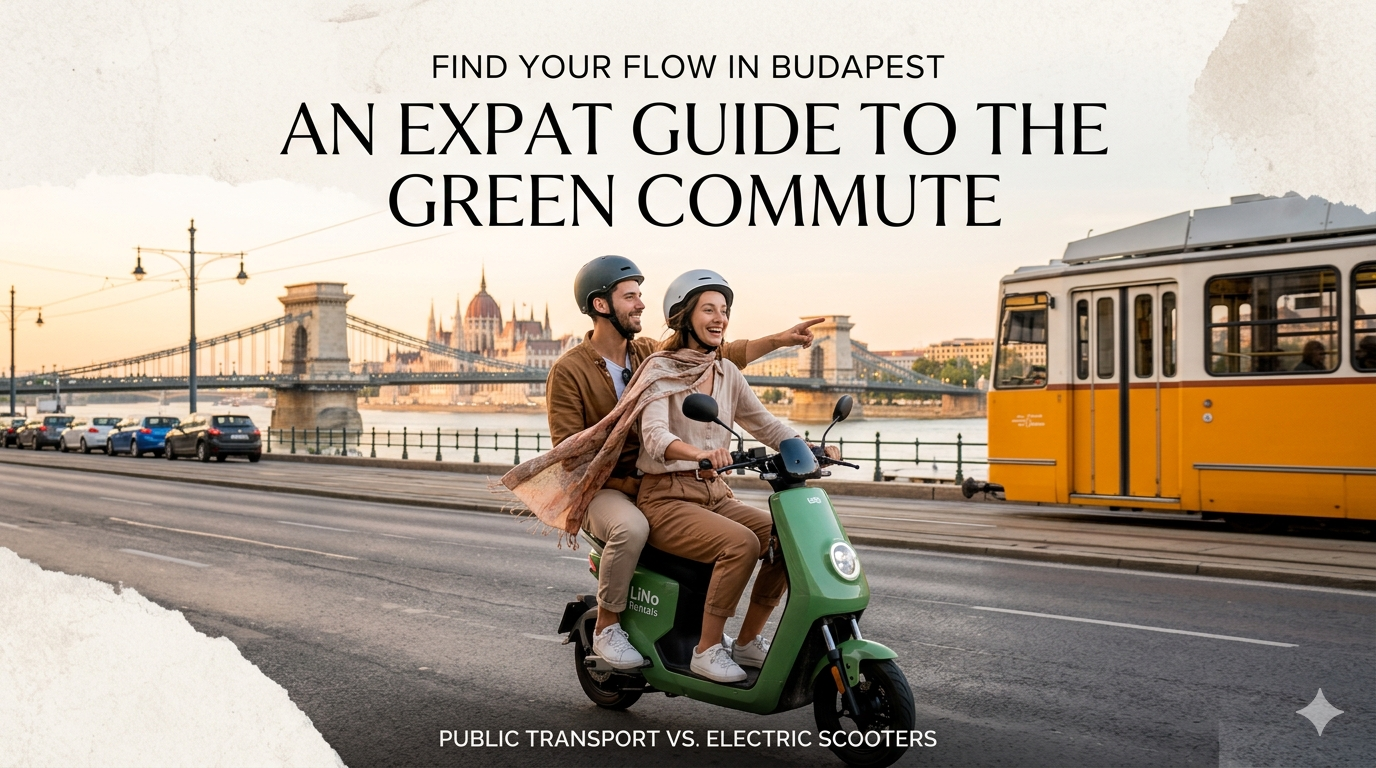
There is a specific, magical feeling that comes with your first few weeks as an expat in Budapest. You walk out of your apartment, and the grand, turn-of-the-century architecture, distant chime of iconic yellow trams, and massive expanse of the Danube slicing the city into two distinct personalities instantly greet you. Buda is a sleepy, rolling landscape of green hills; Pest is a buzzing, flat grid of cafes, ruin bars, and creative energy.
But once the initial honeymoon phase settles, reality knocks on the door. You have to get to a co-working space in District VI, meet a friend at a hidden garden cafe in District VIII or watch the sunset from the Citadel walls in Buda.
Suddenly, you realize that figuring out the best way of getting around Budapest efficiently, affordably, and mindfully is one of the biggest hurdles to truly settling in.
Should you rely entirely on the transit system? Is it worth buying a car? Or is there a better, greener way to find your flow in the Pearl of the Danube? Let’s break down the reality of navigating the city as a newcomer.
How to Get Around Budapest via Public Transit (BKK)
Let’s give credit where it’s due: Budapest has one of the most extensive and visually iconic public transportation networks in Europe. Between the historic M1 metro line (the oldest underground railway in continental Europe), the hyper-efficient Tram 4-6, and a massive web of buses and trolleybuses, BKK transit is usually the first option people try when learning how to get around Budapest. It’s affordable, and the BKK BudapestGO App makes tracking rides relatively simple.
However, relying solely on public transit comes with a hidden tax on your peace of mind:
- The “Sweat & Squeeze” Factor: If you’ve ever tried to board Tram 4-6 at Blaha Lujza tér during Tuesday morning rush hour, or stood shoulder-to-shoulder on a packed metro car in the dead of July, you know it isn’t exactly a mindful experience.
- The Last-Mile Problem: Budapest is vast. Often, getting to that perfect artisan bakery or your new gym requires a tram, a metro transfer, and a 12-minute walk. When it’s freezing in January or pouring rain in November, those transfers lose their charm quickly.
- Missing the Cityscape: Spending your daily commute underground means you are entirely disconnected from the city you moved here to experience. You miss the quiet side streets, the sudden views of the Parliament, and the changing seasons along the tree-lined avenues.
Is Driving the Best Way to Get Around Budapest?
he knee-jerk reaction for many expats who want total autonomy is to look into buying a car or relying heavily on ride-sharing apps.
Unless you are frequently traveling outside of Hungary, owning a car in central Budapest is rarely the best way to get around Budapest. The city center is notoriously congested, and parking zones are strictly regulated and expensive—finding an open spot in Districts V, VI, or VII can easily eat up 20 minutes of your life every single day.
Add to that the mountain of Hungarian vehicle registration paperwork (not beginner-friendly if you don’t speak the language), and the dream of car ownership quickly fades.
Comparing the Best Ways to Get Around Budapest
When looking for the easiest way to get around Budapest, your choice depends on whether you value low cost, speed, or complete personal autonomy. Here is how the top modes stack up for daily expat life:
| Commute Mode | Best For | Main Advantage | Major Drawback |
| BKK Public Transit | Long cross-city journeys | Low cost, wide coverage | Crowded at peak hours, transfer delays |
| Car Ownership | Regional trips outside Budapest | Complete personal space | Severe traffic & costly, difficult parking |
| Pay-Per-Minute Scooters | Spontaneous 5-minute rides | Easy to find on street corners | Extremely expensive for daily commutes |
| Monthly E-Scooter Rental | Daily expat commutes & flexibility | Fixed low cost, low effort, zero maintenance | Requires a place to charge at home |
E-Scooters & Bikes: The Easiest Way to Get Around Budapest
Over the last few years, a quiet revolution has been happening on Budapest’s asphalt. The city has steadily expanded its network of dedicated bike lanes, cutting through major arteries like the Grand Boulevard (Nagykörút) and stretching beautifully along both sides of the Danube bank.
Moving to two wheels changes your entire relationship with getting around in Budapest. You start choosing routes based on scenery rather than speed. You smell the freshly baked pastries from the local pékség, feel the morning breeze off the river, and take control of your schedule—no waiting for delayed buses, zero parking fees, and zero carbon footprint.
Why E-Bikes and E-Scooters Excel in Buda’s Hills
While a classic bicycle is fantastic for flat Pest, Budapest has a secret weapon: the Buda hills. If you live or work on the Buda side, or simply want to explore places like Normafa or Gellért Hill, a standard bicycle means arriving at your destination completely exhausted and drenched in sweat.
This is where electric micro-mobility—e-bikes and electric scooters—changes the game. They give you the open-air, eco-friendly benefits of a bicycle, but with the necessary power to glide up Budapest’s steepest inclines effortlessly.
Long-Term E-Scooter Rental: A Cost-Effective Commute
When most expats think of electric scooters in Budapest, they picture the bright public rental scooters scattered across the sidewalks. While these are convenient for a random tourist joyride, using them for daily commuting is a trap. Pay-per-minute fees add up shockingly fast, making them more expensive than a taxi over a month. Plus, there is no guarantee a fully charged, well-maintained scooter will be waiting outside your door when you’re running late for a meeting.
The real life hack for digital nomads and long-term expats is opting for a personal, long-term monthly rental.
Instead of paying by the minute or investing thousands of euros into buying your own vehicle, services like LiNo Rentals allow you to rent a dedicated electric scooter or electric motorcycle on a flexible, weekly, or monthly basis.
It completely removes the traditional stress of vehicle ownership:
- Zero Maintenance Stress: Mechanical upkeep and repairs are fully handled for you.
- All Gear Included: Comes equipped with the necessary charging gear and locks.
- Expat-Friendly Contracts: Flexible packages mean you aren’t locked into multi-year commitments if you’re only in Hungary for a season.
It gives you a reliable, fixed-cost way to claim complete transit independence in the city.
Finding Your Unique Flow
Settling into a new country is all about experimenting until you find the routines that make you feel truly at home. For some days, that might mean sitting peacefully on the iconic Tram 2 as it cruises past the Danube. But for the days when you want autonomy, efficiency, and a closer connection to the vibrant streets, nothing matches the freedom of exploring the city on two wheels.
Ready to claim complete transit independence in Budapest? Skip the crowded metro lines and parking stress. Check out LiNo Rentals’ monthly e-scooter options to get a fully serviced, flexible ride delivered straight to your door.
 Szia Soul